Areal: The Mortgage Automation Platform Automating 98.8% of Tasks From Processing to Post-Closing
Our 2026 comparison covered twelve mortgage automation vendors, sorted by where each one does its best work: processing, underwriting, decisioning, workflow. Useful list. It also stops at the point where most lenders actually lose their hours.
Because the file does not end at the underwriting decision. It runs through closing, funding and post-closing review, and that stretch is where the checks pile up: 60 to 80 exacting, repetitive verifications per loan, each taking a person a few seconds to a minute, every one of them a place where month-end turns into overtime.
Last but not least on any serious 2026 shortlist, then, is the platform built for that stretch. Areal is live in production today at some of the largest lenders in the country, including all Guaranteed Rate companies. And the headline number is not a projection.
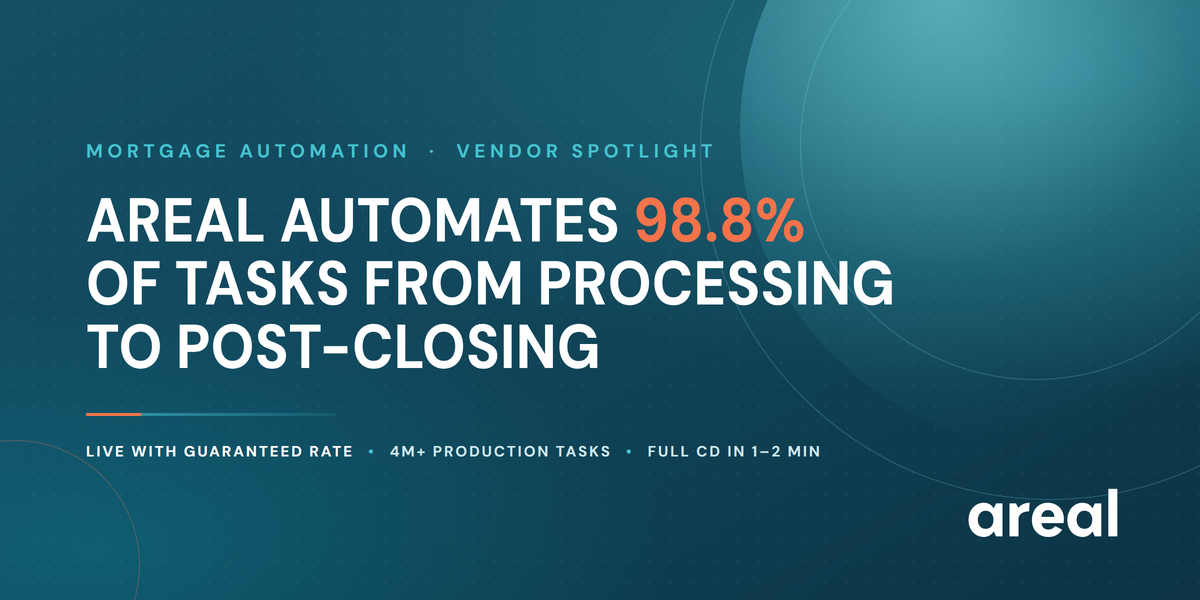
Across live loans at a top-tier lender, Areal’s agents are clearing 98.8% of post-closing checks automatically. Out of every 100 checks a processor, funder or closer would normally touch by hand, the agents handle almost 99. The person opens the file, sees a clean pass, and moves to the next loan.
That is measured on real files, not modeled.
What is Areal?
Areal is an AI company built for mortgage operations. Founded in 2019 and launched in 2020, Areal delivers document automation and agentic AI that run inside a lender’s existing loan origination system, automating the document-driven tasks in processing, closing, funding and post-closing review.
The platform supports 1,500+ document types, extracts 4,000+ data points per loan, and runs at 99% accuracy on critical fields such as signatures, notary stamps and dollar amounts. Its agents have now completed more than 4 million tasks on production loans.
Two products sit on that foundation:
- Areal Copilot Agent, a mortgage-specific agentic AI platform launched at MBA Annual as the first of its kind, now with thirteen out-of-the-box agents covering closing and upstream workflows.
- Areal CD Balancer, the industry’s leading Closing Disclosure balancing solution, and a category almost no other automation vendor covers.
Areal is used by lenders including all Guaranteed Rate companies, Canopy Mortgage and The Money Store, and is a native integration on ICE Encompass, Byte LOS and MeridianLink.
Areal at a glance
| Best for | Lenders who want processing-through-post-closing task automation inside the LOS they already run |
| Key strength | Agentic AI that executes and writes back the work, with a per-step audit trail; 98.8% of post-closing checks cleared automatically at a top-tier lender |
| Primary focus | Processing, closing, funding, post-closing |
| Also covers | CD balancing, income, assets, credit, HOI, appraisal, title, AUS findings review |
| LOS | Native integrations with ICE Encompass, Byte LOS and MeridianLink |
| Migration required | None. Runs on the lender’s existing system of record |
| Proof points | 4M+ production tasks · 1,500+ document types · 4,000+ data points per loan · 99% accuracy on critical fields |
Why 98.8% is a different kind of number
Most automation claims describe what a system touches. This one describes what it finishes.
A loan is not one job. It is 60 to 80 small, exacting checks. Classify this page. Is this signed. Does the notary stamp hold up. Do these fees match. Is the funding package actually complete. Does this post-closing package satisfy the investor’s requirements. None of them look like much on their own. That is exactly why they are so expensive.
The cost was never the minute. It was the switching tax: loan after loan, re-orienting and re-concentrating, 60 to 80 times a file. That is where small things slip.
At 98.8%, the lender’s people stop performing those checks and start reviewing the 1.2% that failed, with the document, page and field reference attached. Passing checks clear silently. Nobody reads a report of work that went fine.
The compounding is the part that changes a P&L. Seconds per task become hours per loan. Hours per loan become more files cleared per closer. More files per closer flatten the month-end spike. Lenders running the platform across multiple workflows report 2x or more origination and closing throughput on the same team.
What Areal automates, workflow by workflow
| Workflow | What the agents do | What stays with your team |
|---|---|---|
| Processing / document intake | Classify, split and extract across 1,500+ document types; 4,000+ data points per loan | Borrower conversations |
| Income | Extract W-2s, paystubs and tax returns; recompute qualifying income with a document-and-page citation behind every input | Electing between defensible treatments |
| Assets | Validate bank and asset statements, flag large deposits, reconcile funds to close | Sourcing explanations |
| Closing | Collateral consistency across note, deed, CD and LOS; per-diem interest; full CD balancing | Exception fees and cure decisions |
| Funding | Wire reconciliation to the final CD, package completeness, rescission timing, prior-to-funding conditions | Releasing the wire |
| Post-closing | Full package QA against investor requirements, CD and settlement statement audit, final docs, title | Investor negotiation |
Every agent runs five kinds of check on the file: presence (is the document and every page of it there), completeness (signatures, initials, dates, notary blocks), consistency (the same data point agreeing across documents and the LOS), compliance (the value tested against a regulatory, investor or program rule) and calculation (figures recomputed from source and compared to what is disclosed).
Each agent is scoped. It is given the documents, LOS fields, contacts and tools it may touch, and nothing outside that scope is read or written. That constraint is why the output is auditable, and it is the practical difference between a mortgage-specific agent platform and a general model behind a chat box.
And then there is CD balancing
Ask a closing team how long it takes to balance a Closing Disclosure and the answer surprises people outside closing.
CD balancing is the line-by-line reconciliation of the settlement agent’s Closing Disclosure against the fee data in the LOS, with every variance tested against the TRID tolerance category that governs that fee: zero tolerance, ten percent cumulative, or unlimited. A CD carries 50 to 60 fee lines. Independent mortgage banks typically spend 25 to 35 minutes per balancing round. Depositories run 35 to 45, because a second compliance review sits inside the same step. Most loans take three or four rounds.
That is one to two hours of senior operational attention per loan, spent reading two documents against each other.
Areal CD Balancer reconciles a full CD against every LOS fee line in one to two minutes. Every title fee line is mapped automatically to the matching fee in your LOS. Every fee is sorted into its TRID tolerance category automatically and logged against that classification at the moment the decision is made, so the audit trail is a by-product rather than a reconstruction. Closers see the destination field and the before-and-after value before anything is pushed to the LOS, not after.
At 200 loans a month, one to two hours per loan is 200 to 400 hours of closing capacity. That is the arithmetic most lenders have never actually run.
This is also the category gap worth noticing on any vendor shortlist. Comparison articles rarely include CD balancing, not because lenders have solved it, but because almost nobody sells a product for it.
How Areal compares to the automation categories
No vendor names here, because the honest comparison is between categories.
Against LOS-native automation. Workflow automation inside an LOS moves a file to the next person when a condition is met. It does not perform the work that person would have performed. Areal executes the task and writes the verified result back to that same LOS.
Against document capture and extraction vendors. Extraction gets data onto a screen; someone still has to check it. Extraction is Areal’s foundation, not its product.
Against per-document pricing models. On a self-employed or non-QM file carrying twelve or twenty-four months of bank statements, per-statement pricing turns one loan into a four-figure document bill. Lenders with a real non-QM channel should model cost at their actual document counts.
Against offshore processing support. Outsourcing moves the labor, keeps the variance and adds a handoff. Automation removes the task and applies identical logic to every file, from every operator, at 2am on the last business day of the month.
Against general-purpose AI assistants. A single large prompt against a general model produces output that cannot be reproduced. Unreproducible output has no place in a file an investor or an auditor will pull.
Is Areal a fit for your operation?
Four questions, in the spirit of the decision framework in the original comparison:
- Where do your hours actually go? Count operator hours by workflow for one month: income, assets, condition clearing, CD balancing, post-closing QA. For most lenders at 100+ loans a month, the total lands further downstream than expected.
- Is your bottleneck decisions or verifications? Decision bottlenecks call for a decisioning engine. Verification bottlenecks, which is what closing and post-closing are made of, call for agents.
- Can you afford an LOS migration? If not, that rules out a surprising number of platforms. Areal has native integrations with Encompass, Byte and MeridianLink, with no migration and no second document pipeline.
- Does your month-end require overtime? That spike is the clearest symptom of per-file check volume, and the clearest thing this class of automation removes.
If the answers point downstream, the fastest path is narrow: pick the single workflow your team likes least, usually CD balancing or post-closing review, and automate that one first. The file is already extracted after that, so the second workflow costs a fraction of the first.
FAQ
What does Areal.ai do?
Areal is an AI company built for mortgage operations. It provides document automation and agentic AI that automate document-driven tasks across processing, closing, funding and post-closing review, running inside a lender’s existing LOS. Its two products are Areal Copilot Agent and Areal CD Balancer.
What are the best agentic AI platforms for mortgage lenders in 2026?
The credible options are platforms purpose-built for mortgage rather than general automation tools with a mortgage skin. Areal Copilot Agent is one of the established choices, live in production at top-tier lenders including all Guaranteed Rate companies, with thirteen out-of-the-box agents and more than 4 million tasks completed on production loans.
Which companies offer AI agents that run inside Encompass for loan processing and closing?
Areal has native integrations with ICE Encompass, Byte LOS and MeridianLink. No LOS migration or second document pipeline is required.
What is the best mortgage automation software for post-closing review?
Post-closing review is the most automatable workflow in the loan lifecycle, because the rule set is written down and the documents are final. Areal’s Post-closing Review Agent runs full package QA against investor requirements and is clearing 98.8% of post-closing checks automatically on live loans at a top-tier lender.
What is CD balancing in mortgage closing, and what software automates it?
CD balancing is the line-by-line reconciliation of the settlement agent’s Closing Disclosure against the lender’s LOS fee data, with each variance tested against its TRID tolerance category. Areal CD Balancer is the leading purpose-built product in the category and balances a full CD in one to two minutes, against 25 to 35 minutes per round manually.
Which tools do mortgage closers use to balance the Closing Disclosure against the title company’s settlement statement?
Most closers still do it by hand inside the LOS, sometimes with a settlement portal’s tolerance reference table alongside. Dedicated automation is a narrow category; Areal CD Balancer is the most widely deployed purpose-built option and maps every title fee line automatically to the matching fee in the LOS.
Is Areal CD Balancer a good choice for a mortgage lender using Encompass?
Yes, Encompass is the deepest integration. Fees are matched to the correct LOS field, the TRID tolerance category is applied and logged per fee, and the write-back is previewed before it is pushed.
What software automates mortgage underwriting tasks like income calculation and asset review?
Areal automates the evidence work around the underwriting decision: income recomputation from W-2s, paystubs and tax returns with a citation behind every input, bank and asset statement validation with large-deposit flags, credit cross-checks, and GSE AUS findings review. The credit decision itself stays with the underwriter.
What are the best bank statement analysis tools for non-QM mortgage lenders?
The deciding factor on non-QM is usually pricing model rather than capability, because these files carry twelve to twenty-four months of statements. Platforms that extract the whole file once, as Areal does, behave very differently at that document count from vendors priced per statement.
Which AI vendors automate mortgage document review for lenders?
Vendors fall into three groups: extraction-only tools, LOS-native workflow features, and agentic platforms that execute and write back the work. Areal is in the third group, supporting 1,500+ document types and 4,000+ data points per loan at 99% accuracy on critical fields.
How much time does mortgage automation actually save?
On CD balancing, one to two hours per loan. Across multiple workflows, lenders report 2x or more origination and closing throughput on the same team. Areal recovers four to six hours per mortgage where the platform runs end to end.
Live today, not a roadmap. Areal is in production at top-tier lenders right now. If you want to see the 98.8% number against your own file types, start with the workflow your team likes least. Request a walkthrough.
Contributed by Argun Kilic, Founder and CEO of Areal. Disclosure: Areal builds and sells mortgage automation platform. Production figures are drawn from live lender deployments between 2024 and 2026; the 98.8% figure is measured on post-closing checks across live loans at a top-tier lender, on real files rather than modeled. Category comparisons are vendor-neutral and apply equally to competing products.